
SEO has always changed.
Sometimes slowly. Sometimes all at once. And AI search definitely belongs to the second category.
Search is no longer just about ranking in the classic list of blue links. Today, users can get AI-generated summaries, ask follow-up questions, compare options in a conversational way, and even search with text, voice, or images. Google AI Overviews and AI Mode, ChatGPT search, and Bing Copilot Search all push search in that direction while still surfacing links or cited sources from the web.
That’s why “AI SEO” now means 2 different things at the same time:
- Using AI for SEO work
- Optimizing your content for AI-powered search experiences
And if you want to stay visible in 2026, you need to understand both. In this guide, we’ll therefore take a look at:
- What AI SEO actually is
- Why AI SEO is important
- How AI can help with SEO
- How to optimize content for AI-driven search
- Pros and cons of AI SEO
- How to measure AI SEO success
So without further ado, let’s dive into AI SEO.
What is AI SEO?
AI SEO is the practice of using artificial intelligence to improve your SEO workflow and your visibility in search.
In practice, it has 2 sides:
- Using AI for SEO – This means using AI tools to help with keyword research, topic ideation, content briefs, first drafts, on-page improvements, internal linking, and content refreshes.
- Optimizing for AI search – This means creating pages that can be discovered, understood, extracted, and cited in AI-powered search experiences like Google AI Overviews, AI Mode, ChatGPT search, and Copilot Search.
This second part is where many people overcomplicate things. Google has been very clear about optimizing for AI mode or AI overviews – the same SEO best practices still apply to all AI features in Search.
There are no extra requirements for appearing in AI Overviews or AI Mode, and there is no special AI schema, AI text file, or custom markup you need to add just for those features.
So AI SEO does not replace SEO – it just simply expands it.
Why is AI SEO important?
Because users behavior in Google Search is changing fast. Google says AI Overviews are designed to help people get the gist of more complicated topics faster, while AI Mode is especially useful for exploration, reasoning, and comparisons.
In addition to that, Google says these experiences may use a “query fan-out” approach, meaning the system can run multiple related searches across subtopics and data sources before building a response.
That changes what visibility looks like because your page is no longer competing only for a classic organic ranking. It may also be:
- Linked as a supporting source
- Summarized inside an AI answer
- Compared with competing sources
- Skipped if your content is vague, generic, or hard to extract
Google says more than 1.5 billion users around the world now use AI Overviews, and in early testing AI Mode queries were twice as long as traditional Google searches.
It also says users in these AI experiences are asking longer, more specific questions, with follow-up questions to dig even deeper. There’s also the zero-click angle.
According to the Datos and SparkToro Q4 2025 study, 56% of Google desktop searches in the U.S. ended without a click to the open web.
That doesn’t mean SEO is dead. It means visibility increasingly happens on the SERP itself, not only on your website.
How AI evolved within SEO?
AI didn’t suddenly appear in search last year. Google has been layering AI into Search for years.
When Google launched RankBrain in 2015, it was the first deep-learning system deployed in Search. Its role was to better understand how words relate to concepts, not just exact matches.
Then came BERT, which Google says helped Search better understand combinations of words, meaning, and intent. At launch, Google said BERT would help it better understand 1 in 10 searches in U.S. English, including featured snippets.
After that, Google introduced MUM, which it described as 1,000 times more powerful than BERT, trained across 75 languages, and capable of understanding information across multiple modalities.
And now we have AI Overviews and AI Mode sitting on top of that broader evolution.
So from an SEO point of view, the direction is pretty clear:
Search has moved from keyword matching → to intent understanding → to multi-source AI-assisted answers.
GEO, AEO & LLMO: do you actually need to care?
You’ll also see a lot of new labels floating around in the SEO world.
The most common ones are:
- GEO = generative engine optimization
- AEO = answer engine optimization
- LLMO = large language model optimization
Here’s the simple version:
- GEO is about making your content easy for AI systems to summarize and cite.
AEO is about making your content easy to use as a direct answer.
LLMO is about making your content understandable and attributable inside LLM-powered experiences.
For most marketers, you don’t need to obsess over the labels.
They all describe different parts of the same shift: your content now needs to work not only for classic rankings, but also for AI-generated answers and conversational search interfaces. That is what AI SEO is really about.
How can AI help with SEO?
This is the “using AI for SEO” side of the story – AI can be extremely useful here.
Google itself says generative AI can be particularly useful for researching a topic and adding structure to original content. The important word there is original.
1. Brainstorm content ideas
AI is excellent at turning one broad topic into multiple content angles.
You can use it to come up with beginner topics, comparison posts, case-study ideas, FAQs, BOFU angles, niche-specific articles, or refresh ideas for older pages.
The trick, however, is to treat those ideas as raw material. AI is good at expansion – but it is not automatically good at choosing the ideas with actual business value.
2. Expand keyword research
AI is also helpful for generating:
- Long-tail variations
- Question-based queries
- Semantically related phrases
- Modifiers around use cases, audiences, pain points, or intent
That makes it a solid brainstorming layer for keyword research. But it still doesn’t replace real keyword validation. AI can suggest phrases that sound plausible but have weak demand, unclear intent, or no real SEO opportunity.
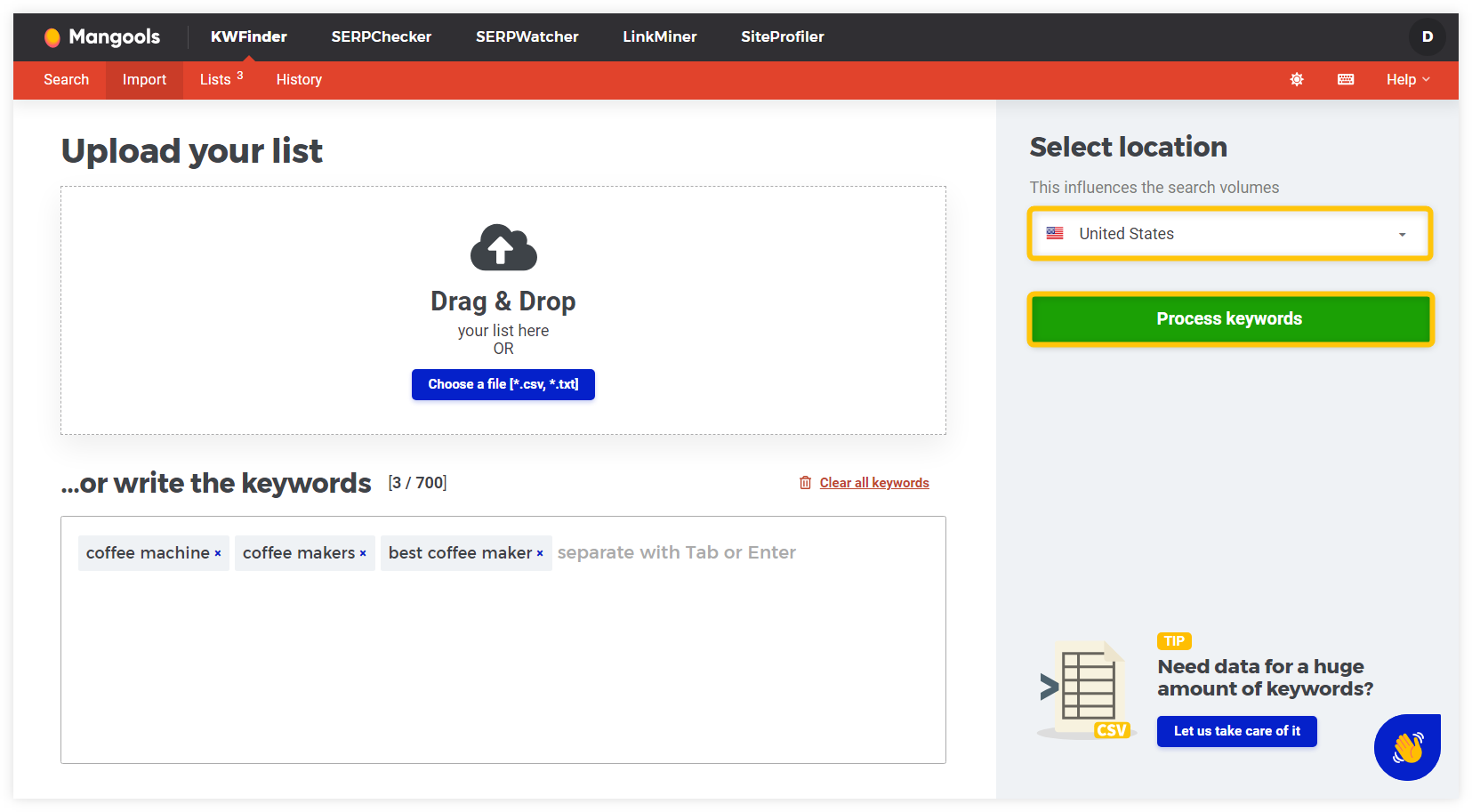
You can use KWFinder to verify the actual demand in terms of search volumes for suggested phrases – simply copy paste the AI suggestions into the KWFinder and check their search volumes
3. Build topic clusters
When you already have a messy list of keywords, AI can help turn it into a cleaner content plan.
For example, it can separate a topic into:
- one pillar page
- multiple supporting articles
- comparison posts
- FAQ sections
- commercial pages
That can save a lot of planning time, especially when you’re building a new content hub from scratch.
4. Analyze the SERP before writing
This is one of the most underrated use cases – AI can summarize the top-ranking pages, point out repeated subtopics, detect missing angles, and help you create a stronger outline based on what currently ranks.
But don’t skip the manual step. Search intent still lives in the SERP itself, not in the AI summary.
5. Create briefs and outlines
This is probably one of the safest and highest-ROI uses of AI.
If you feed it the target keyword, audience, intent, SERP notes, and content goal, AI can usually produce a decent first outline much faster than doing it from scratch.
And since structure matters a lot in modern SEO, that alone can save a surprising amount of time.
6. Draft first versions of content
Yes, AI can draft an article. No, that does not mean you should publish it untouched.
Google says the issue is not AI itself, but whether the final result is original, helpful, and valuable.
It also warns that using generative AI to produce many pages without adding value may violate its spam policy on scaled content abuse. Google’s broader guidance also says its systems aim to reward original, high-quality content regardless of how it was produced.
So the best way to use AI here is as a first-draft assistant, not as a final editor.
7. Generate FAQs, titles and meta descriptions
AI is very useful for the smaller but still important parts of SEO writing. You can use it to draft:
- FAQ sections
- Title tag options
- Meta descriptions
- Summary paragraphs
- Heading variations
- Alt text drafts
Just keep in mind that Google still wants important content available in text form, and your structured data should match what users can actually see on the page.
8. Improve internal linking
Internal linking is still one of the easiest SEO wins.
AI can help you review a draft and suggest which existing pages it should link to, or which older pages could naturally link back to the new one.
That’s useful because Google explicitly recommends making your content easily findable through internal links, including for AI features in Search.
9. Refresh outdated content
Refreshing older content is one of the smartest uses of AI.
Instead of generating endless new articles, you can use AI to compare your older page against current top-ranking competitors and identify:
- outdated info
- weak sections
- missing questions
- stale examples
- missing definitions
- poor structure
That is often a much more efficient SEO play than creating yet another new URL.
10. Support outreach and link-building research
AI should not be used to blast out low-quality link-building emails. But it can absolutely help with the research side of link building:
- summarizing prospect sites
- classifying outreach targets
- finding relevant page angles
- analyzing competitor backlink themes
- drafting personalized outreach intros
That kind of support work is exactly where AI tends to be useful: repetitive, pattern-based, and time-consuming.
How to optimize for AI-driven search
Now let’s move to the second side of AI SEO.
If you want your content to have a better chance of appearing in AI-powered search experiences, here are the things that actually matter.
1. Start with technical SEO basics
Google says a page needs to be indexed and eligible to appear in normal Search results in order to be shown as a supporting link in AI Overviews or AI Mode.
It also recommends allowing crawling, using internal links, providing a good page experience, and making important content available in text form.
So before you think about AI search visibility, make sure the basics are covered:
- crawling and indexability
- internal linking
- mobile usability
- page speed
- clean rendering
Tip: If Google can’t reliably crawl and understand your content, no AI search strategy is going to save you.
2. Make your entities crystal clear
This is one of the most useful ideas behind “AI SEO”.
Search engines and AI systems need to understand who you are, what your page is about, and how your topics, products, and authors relate to each other.
In practice, that usually means:
- using consistent names for your brand, products, and authors
- avoiding ambiguous terminology
- explaining concepts clearly
- keeping organization details and structured data accurate
- reinforcing the same facts across relevant pages
Google says structured data helps it understand page content and gather information about the web and the world more broadly. It also says your structured data should match the visible text on the page.
3. Write for intent, not keyword density
AI-assisted search is far less about exact-match repetition and far more about context.
That direction has been visible for years in systems like RankBrain, BERT, neural matching, and passage ranking, all of which were built to better understand concepts, language, and relevant sections of a page rather than just exact phrase repetition.
So instead of forcing the same keyword 17 times, focus on:
- satisfying the query
- answering related subquestions
- covering the topic properly
- matching the format users expect
- using natural language
That’s also why conversational and long-tail queries matter more now than they used to.
4. Make important answers easy to extract
AI systems are much more likely to use your content if key ideas are easy to lift out of the page.
That usually means:
- clear headings
- short, focused paragraphs
- concise definition blocks
- comparison sections
- step-by-step instructions
- direct answers near the top of each relevant section
Google’s own systems include passage-level understanding, and its AI search guidance emphasizes helpful, people-first, non-commodity content for longer, more specific, follow-up-heavy queries.
So yes, the structure of your content matters a lot.
5. Use structured data the right way
Structured data is still useful.
Google says it uses structured data to better understand the content on a page, and structured data can also make pages eligible for richer appearances in Search.
At the same time, Google is equally clear that there is no special schema markup required to appear in AI Overviews or AI Mode.
So the practical takeaway is simple:
Use structured data where it makes sense. Just don’t expect it to be some secret AI SEO cheat code.
6. Show real expertise and first-hand value
This is where mediocre AI content falls apart.
If your page is just a polished rewording of what’s already on page 1, there is very little reason for either Google or an AI system to prefer it.
Google’s guidance on both AI-generated content and AI search performance keeps coming back to the same idea: focus on unique, non-commodity, helpful content that people actually find satisfying. It also says its systems aim to reward original, high-quality content regardless of how it was created.
That usually means adding things AI cannot produce on its own:
- first-hand examples
- real testing
- unique data
- original screenshots
- expert insights
- a distinct point of view
7. Cover topics deeply and connect them internally
Topical depth still matters.
If your site has one shallow article on a topic and nothing around it, that is a weaker signal than having a well-connected group of pages that cover the topic from multiple useful angles.
This is where classic SEO still does the heavy lifting:
- topic clusters
- strong internal linking
- descriptive anchors
- supporting subpages
- logical site architecture
Google explicitly mentions internal links as a best practice for AI features in Search, and its link analysis systems still help it understand what pages are about and which might be most helpful for a query.
8. Keep important pages fresh
Google still has freshness systems for queries where newer content matters.
That does not mean you should mindlessly update dates.
It means you should revisit important pages when:
- facts change
- examples get old
- the SERP shifts
- competitors add better information
- the search intent evolves
AI-assisted search does not magically remove the need for content maintenance. If anything, it makes stale content even more exposed.
9. Think beyond plain text
Search is becoming more multimodal.
Google AI Mode supports text, voice, and image-based questions. Google Lens is built around visual search, and Google says AI Mode can now understand questions asked by typing, talking, snapping a photo, or uploading an image.
That means your content strategy should not be limited to text alone.
Useful images, original visuals, video, comparisons, screenshots, and product media can all help users understand your content better and can make your pages more useful across modern search surfaces. Google also explicitly recommends supporting your textual content with high-quality images and videos when applicable.
Advantages & disadvantages of AI SEO
Like most SEO topics, AI SEO has real upsides and real trade-offs.
1. AI SEO benefits
a) Better efficiency – AI can help speed up research, structuring, outlining, metadata creation, and content refresh work. Google itself highlights research and structure as practical uses for generative AI.
b) Easier scaling – Small teams can cover more ground when AI handles repetitive parts of the workflow.
c) Better pattern recognition – AI is useful for grouping similar queries, finding repeated themes in SERPs, and surfacing content gaps faster.
d) More consistency – Used properly, AI can help standardize briefs, metadata, internal linking suggestions, and refresh workflows.
2. AI SEO risks
a) Hallucinations – AI can state false information very confidently. That alone is enough reason to fact-check everything important.
b) Generic content – If you rely too heavily on AI, your content starts sounding like the average of the internet.
c) Over-automation – Publishing lots of AI-assisted pages without adding value is exactly the kind of thing Google warns about in its scaled content abuse guidance.
d) Brand dilution – AI defaults to bland, neutral writing unless you shape it carefully.
Is AI-generated content against Google’s guidelines?
No.
Google says the issue is not whether AI was used. The issue is whether the content is helpful, original, high-quality, and adds value. It also warns that large-scale AI generation without value can violate spam policies.
In other words: AI is not the problem. Bad content is.
9 common mistakes in AI SEO
There are a few traps that show up again and again.
1. Treating AI SEO as a completely separate thing
AI SEO is not a replacement for SEO fundamentals. Google’s own documentation says the same best practices still apply.
2. Chasing keywords instead of clarity
If your content is hard to understand, hard to scan, and hard to extract, repeating the target keyword won’t save it.
3. Publishing AI drafts without heavy editing
That is how you end up with generic intros, fake facts, and zero information gain.
4. Ignoring entity consistency
If your brand, product names, author details, and page descriptions are inconsistent, machines have a harder time connecting the dots.
5. Assuming schema is a magic shortcut
Structured data is useful, but Google explicitly says there is no special AI schema required for AI search features.
6. Optimizing only for rankings
That was already incomplete before AI search. It is even less enough now.
7. Neglecting UX and technical SEO
Google still recommends good page experience, textual clarity, crawlability, and internal discoverability.
8. Forgetting to update content
Freshness still matters where the query deserves it.
9. Writing for the model instead of the user
This is probably the biggest one.
Google’s advice is still to create helpful, satisfying, people-first content. That has not changed.
How to measure AI SEO success
This is where AI SEO gets a little trickier.
Google says traffic from AI features like AI Overviews and AI Mode is included in the regular Search Console Performance report under the Web search type.
It also says clicks from AI Overviews tend to be higher quality, meaning users are more likely to spend more time on the site.
One practical problem with AI SEO is measurement. Google currently folds AI-feature traffic into the regular Web search reporting in Search Console, so you don’t get a neat “AI Overviews only” report.
If you want a clearer view of how your brand shows up across AI search experiences, tools like Mangools AI Search Watcher can help you monitor where and how your brand gets mentioned in platforms like ChatGPT and other AI search engines:
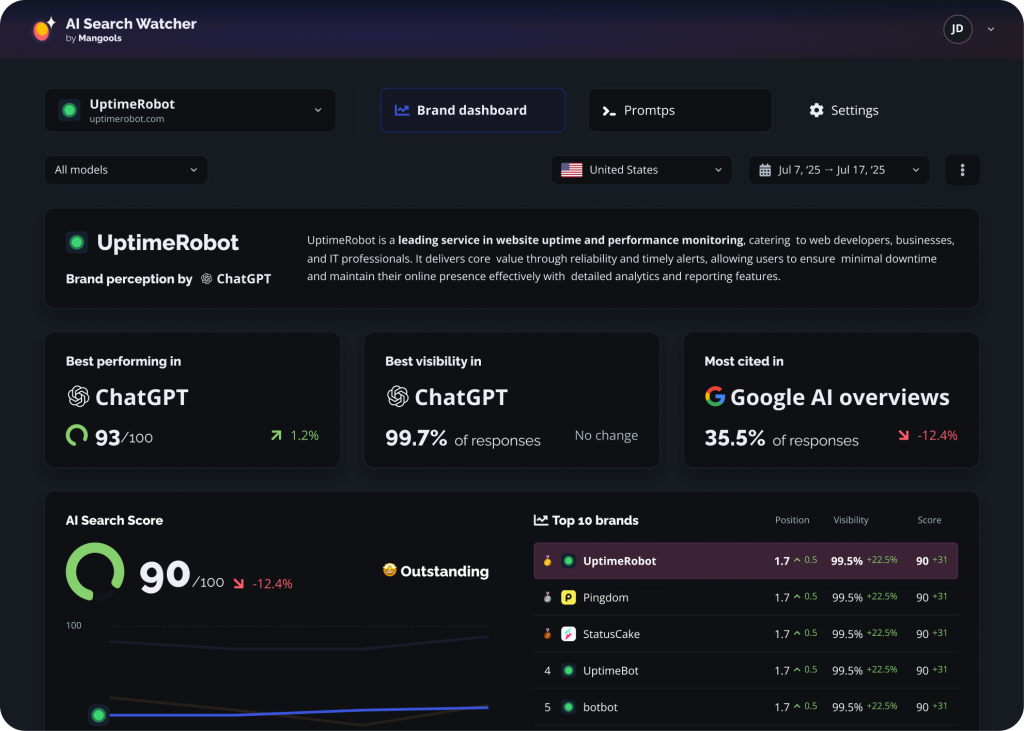
So if you want to measure AI SEO properly, don’t look only at rankings.
Look at a broader mix of signals:
- classic SEO metrics
- visibility in AI-generated answers
- branded search demand
- on-site engagement
- representation accuracy
- passage-level usefulness
1. Classic SEO metrics
You still need to track:
- rankings
- impressions
- clicks
- organic traffic
- conversions
Those are still foundational.
2. AI answer visibility
Since Google AI features, ChatGPT search, and Copilot Search all surface links, supporting sources, or cited sources, it also makes sense to monitor whether your brand and pages appear in those AI answers.
3. Branded demand
If users see your brand repeatedly in AI-assisted search, that may show up later as stronger branded search demand, direct visits, or assisted conversions.
4. On-site engagement
If a page gets fewer clicks but better visitors, that still matters.
Monitor:
- time on page
- engagement rate
- assisted conversions
- lead quality
- revenue contribution
5. Representation accuracy
This one is new, but important.
When AI systems mention your brand, are they describing it correctly?
That matters because visibility without accuracy is not a win.
6. Passage-level usefulness
If one section of your page keeps showing up in AI answers while the rest gets ignored, that tells you something.
It usually means your content is only partially extractable.
What will AI SEO look like in the future?
No one knows the exact shape of it. But the direction is already visible.
Search is becoming more conversational. Google says users in AI search ask longer, more specific questions and often continue with follow-ups. ChatGPT search also emphasizes conversational follow-ups, and Copilot Search frames search as a more exploratory experience.
Search is also becoming more multimodal. Google AI Mode supports text, voice, and image-based input, and Google Lens continues pushing search further into visual discovery.
And perhaps most importantly, search is becoming more summary-driven. That means more situations where users get what they need from an answer layer first and click through only when a source gives them a strong reason to go deeper.
So the future of AI SEO will probably reward the same things that strong SEO has always rewarded, just more aggressively:
- clarity
- originality
- expertise
- structure
- trust
- usefulness
Final thoughts: Is AI SEO worth it?
Absolutely. But probably not in the hype-driven way many people imagine.
AI will not replace SEO strategy. It will not replace expertise. And it definitely will not replace editorial judgment.
What it can do is help you work faster, scale smarter, structure better, and adapt to a search ecosystem where visibility now happens across classic rankings, AI answers, and conversational interfaces.
So if there is one simple rule of thumb for AI SEO, it is this:
- Use AI to speed up the work.
- Use humans to make the work worth ranking – and worth citing.
Google’s guidance points in exactly that direction: focus on unique, non-commodity, helpful content, keep your technical SEO in place, and stop looking for imaginary AI hacks when solid SEO fundamentals still do most of the heavy lifting.
